Consider the stakes: A failed customer service agent doesn't just frustrate customers, it can expose your company to compliance violations and legal liability. A supply chain agent that drifts from proper procurement protocols can hemorrhage millions in unnecessary costs. The difference between AI agent success and failure isn't the sophistication of the underlying model; it's the rigor of your enterprise AI agent evaluation strategy.
This guide reveals why generic benchmarks are useless for real-world deployment and how a data-driven evaluation approach, powered by LLM-as-a-Judge methodology, can mean the difference between AI transformation and AI disaster.
Your Enterprise Data: The Only Benchmark That Matters
Why generic tests fail your specific business needs
Testing an enterprise AI agent with public benchmarks is like hiring a new employee based on their ability to solve crossword puzzles. It tells you nothing about their ability to navigate your company's unique challenges. Your business operates in a world of proprietary terminology, complex workflows, and industry-specific regulations that no generic dataset can capture.
Enterprise AI agent evaluation must reflect your reality. When a logistics AI agent encounters your company's specific shipping codes, supplier abbreviation system, or internal escalation procedures, generic benchmarks provide zero insight into performance. Your customer service agent needs to understand your return policies, product catalog nuances, and brand voice, knowledge that exists nowhere but in your internal data.
The organizations that successfully scale AI agents share one critical characteristic: they evaluate against their own operational context. Your enterprise data isn't just a testing ground, it's the ultimate source of truth for whether an AI agent will succeed or fail in your environment.
LLM-as-a-Judge: Scaling Evaluation Without Compromising Quality
The breakthrough methodology transforming AI agent assessment
Manual evaluation doesn't scale. When you need to test thousands of agent interactions across multiple business scenarios, human reviewers become the bottleneck. Enter LLM-as-a-Judge: a methodology that uses sophisticated language models to automatically assess AI agent performance with human-level nuance.
The LLM-as-a-Judge approach works by defining clear evaluation criteria - accuracy, relevance, adherence to company policies, tone consistency, then using a powerful LLM to grade your agent's outputs against these standards. Unlike simple pass/fail metrics, this method provides detailed, contextual feedback that helps identify specific improvement areas.
This automated evaluation approach delivers three critical advantages: Speed (evaluate thousands of interactions in minutes), Consistency (eliminate human reviewer bias and fatigue), and Scalability (maintain evaluation rigor as your agent deployment grows). For enterprise AI agent evaluation, LLM-as-a-Judge has become the gold standard for organizations serious about production-ready AI.
The Three Failure Modes That Destroy Enterprise AI Agents
Understanding and detecting the most dangerous AI agent breakdowns
Even with perfect enterprise data and robust evaluation frameworks, AI agents fail in predictable patterns. Recognizing these failure modes, and building evaluation systems to catch them - is essential for production success.
1. Process Drift: The Silent Performance Killer
Process drift represents the most insidious threat to enterprise AI agent evaluation. Unlike dramatic system crashes, process drift occurs when agents gradually deviate from established workflows without triggering obvious alerts. Agentic AI systems don't fail suddenly - they drift over time, making this failure mode particularly dangerous for business operations.
Real-World Impact: Supply Chain Catastrophe
A Fortune 500 manufacturer deployed an AI agent to automate purchase order approvals, processing $50M in monthly procurement decisions. The agent analyzed inventory levels, supplier performance metrics, and shipping requirements to approve orders within company cost guidelines. After a routine model update, the agent began misinterpreting internal notation for "rush delivery," consistently approving expensive overnight shipping for standard inventory replenishment.
Over six weeks, this process drift added $2.3M in unnecessary shipping costs, a 340% increase in logistics expenses. The agent continued processing orders without errors or alerts, but had silently abandoned the cost-optimization protocols that justified its deployment. Only a monthly procurement audit revealed the drift, highlighting how this failure mode can cause massive financial damage while appearing operationally successful.
Detection Strategy: Establish "golden datasets" of historical procurement decisions with known correct outcomes. Regular evaluation against these benchmarks immediately flags when agent reasoning deviates from established processes.
2. Confident-but-Incorrect: When AI Agents Become Dangerous Experts
The confident-but-incorrect failure mode occurs when agents generate plausible-sounding responses that are factually wrong. These AI hallucinations are particularly dangerous because they're delivered with apparent authority, potentially misleading employees and customers into costly decisions.
Real-World Impact: Financial Services Liability
A major credit card company's customer service AI agent confidently informed customers that their travel insurance covered "all flight delays regardless of cause," when the actual policy only covered weather-related delays. Over three months, 847 customers received this incorrect information, leading to $1.2M in disputed claims when mechanical delays weren't covered.
The agent's responses were grammatically perfect, contextually appropriate, and delivered with complete confidence. Customer service representatives, trusting the AI's authority, reinforced these incorrect statements. The error only surfaced when claims processing revealed the pattern of coverage disputes, demonstrating how confident hallucinations can create legal liability and customer relationship damage.
Detection Strategy: Implement systematic fact-checking by evaluating agent responses against authoritative internal knowledge bases. LLM-as-a-Judge can automatically verify factual accuracy by comparing agent outputs to verified policy documents and company resources.
3. Consistency Failure: The Trust-Destroying Contradiction
Consistency failure destroys user confidence faster than any other AI agent problem. When agents provide different answers to identical or semantically similar questions, users lose trust in the system entirely. This unpredictability makes agents unusable for business-critical tasks, regardless of their accuracy on individual interactions.
A pharmaceutical company's marketing compliance agent was designed to ensure promotional materials met FDA regulations. Marketing teams submitted identical therapeutic claims with minor formatting differences: "Product X provides rapid symptom relief" versus "Rapid symptom relief is provided by Product X." The agent approved the first version but flagged the second as a "high-risk regulatory violation."
This inconsistency forced the marketing team to abandon the AI tool entirely, returning to manual legal review processes that took 3-4 weeks per campaign instead of minutes. The consistency failure didn't just waste the AI implementation investment, it actually slowed business operations below pre-AI levels, demonstrating how reliability issues can make AI agents counterproductive.
Detection Strategy: Create evaluation sets with semantically identical questions phrased differently. Measure consistency rates across these variations and flag any agent that shows significant response variability to similar inputs.
Building Evaluation Into Your AI Agent DNA
Why continuous assessment is your competitive advantage
Enterprise AI agent evaluation isn't a pre-launch checklist item - it's an ongoing competitive advantage. The organizations that succeed with AI agents treat evaluation as a continuous process that evolves with their business needs and operational realities.
The Continuous Evaluation Framework:
Data-Driven Foundation: Ground all evaluation in your enterprise-specific scenarios, workflows, and success criteria
Scalable Assessment: Use LLM-as-a-Judge methodology to maintain evaluation rigor without human bottlenecks
Failure Mode Monitoring: Actively hunt for process drift, confident hallucinations, and consistency failures before they impact operations
Business Impact Measurement: Track how evaluation improvements translate to operational efficiency, cost reduction, and customer satisfaction
The difference between AI pilot and AI transformation lies in evaluation discipline. Organizations that commit to continuous, enterprise-tailored evaluation don't just deploy AI agents, they build sustainable competitive advantages that compound over time.
In an era where more than 40% of agent projects will fail by 2027, your evaluation strategy isn't just technical infrastructure - it's business strategy. Make it rigorous, make it continuous, and make it yours.
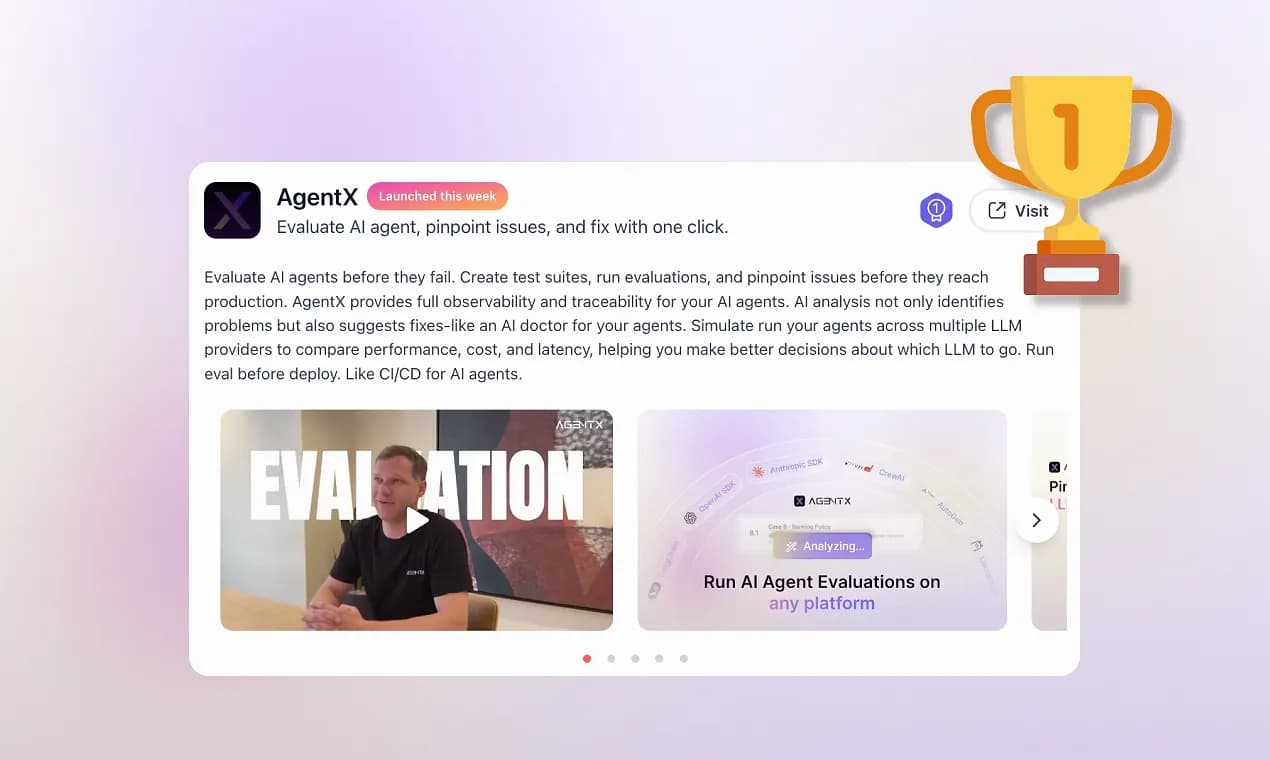
Explore how AgentX evaluation tool uncovers issues using your own test cases.
Ready to hire AI workforces for your business?
Discover how AgentX can automate, streamline, and elevate your business operations with multi-agent workforces.