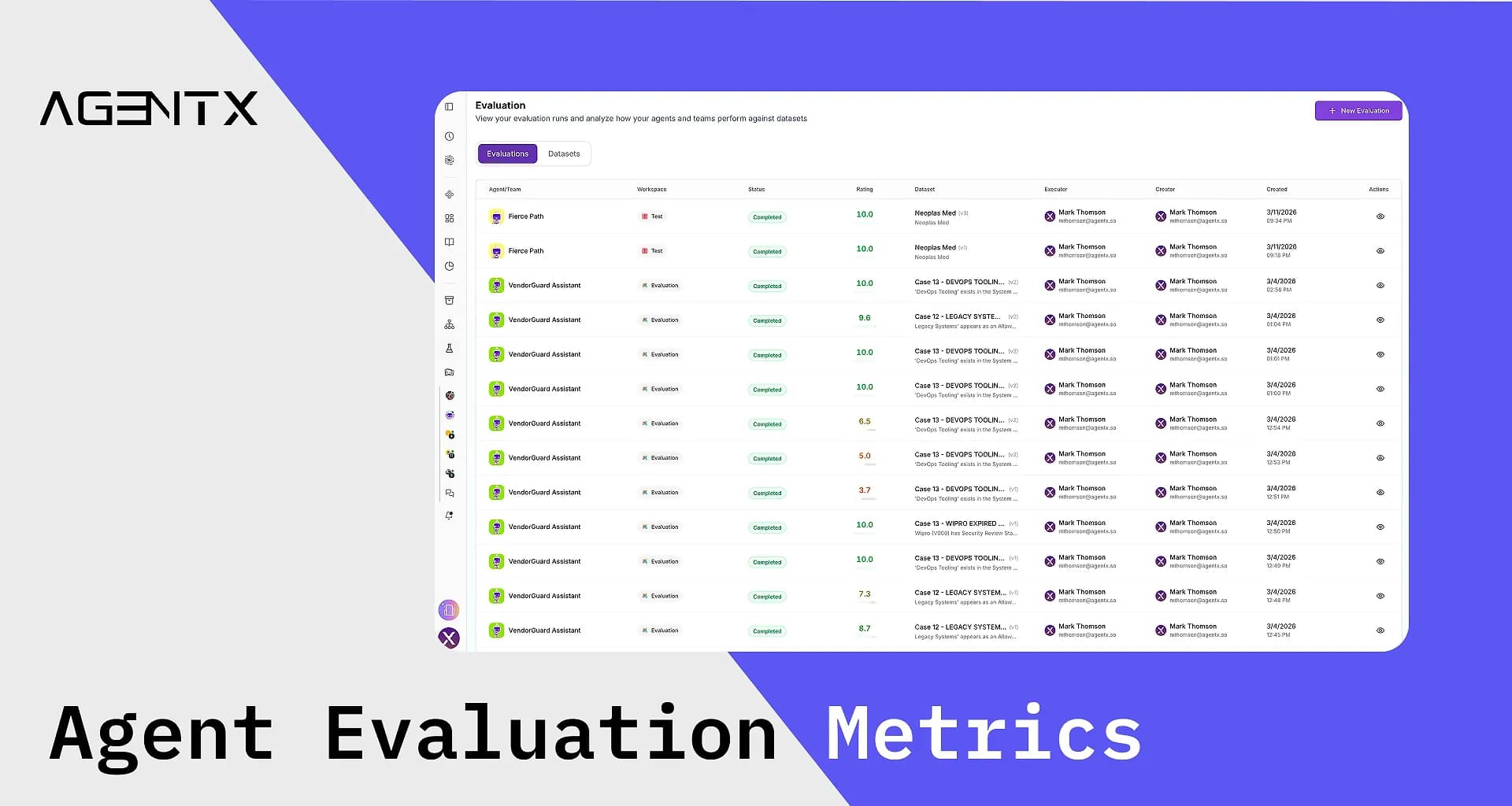
Traditional agent benchmarks measure outcomes, not behavior. An agent may arrive at the correct answer while ignoring constraints, exploiting shortcuts, or fabricating intermediate steps, and the benchmark would still mark it as successful.
You have built an AI agent. It demos beautifully. Stakeholders are excited. Then it hits production, and things get messy. Responses drift. Tasks go unfinished. Users stop trusting it. And nobody can explain why because nobody defined what "good" looks like in the first place.
For AI product leaders, platform evaluators, and technical decision-makers, this is no longer acceptable. In 2026, AI agents are moving fast into production environments, and evaluation is the discipline that separates teams shipping reliable, high-performing agents from those constantly firefighting.
It’s More Than “Pass or Fail”
Traditional software either works or it does not. You write a test, define an expected output, and the code passes or fails. AI agents operate in a far more probabilistic space. They handle natural language, make multi-step decisions, call external tools, and adapt to context. The same input can produce a different output on two separate runs, and both outputs might be "correct" in different ways. An agent might score well on a public benchmark and still fail to handle the nuanced, domain-specific tasks your customers actually need.
Standard benchmarks tell you how a model performs on general tasks, while custom metrics tell you whether your AI agent meets your specific business goals. [Read LLM Eval]
The Core Agent Evaluation Metrics
Evaluating AI agents requires covering task success, business value, reasoning quality, compliance, and scalability to ensure reliable, safe deployment.
Agent Logic Flow
Evaluates whether the agent follows the intended execution flow instead of bypassing critical steps or taking unintended shortcuts. This includes verifying correct task decomposition, proper delegation between agents, accurate tool and MCP selection, valid parameter construction, correct data requests, and reliable query generation. The goal is not just to confirm task completion, but to ensure the agent arrives at the outcome through the expected reasoning and operational process. And avoid hallucinated false positive.
Measures end-to-end execution latency across every component involved in the agent pipeline. This includes LLM response time, inter-agent communication overhead, tool and MCP invocation latency, script execution duration, external API response times, retrieval and RAG latency, database or search query performance, and orchestration overhead. The objective is to identify bottlenecks and understand how each subsystem contributes to total response time and user experience.
Token Efficiency
Assesses how effectively the agent utilizes tokens relative to the quality and completeness of the output. This includes measuring unnecessary prompt expansion, redundant reasoning, repeated context usage, excessive tool-call chatter, and inefficient intermediate generations. A token-efficient agent minimizes cost and latency while preserving accuracy, reasoning quality, and response usefulness.
Consistency and Behavioral Stability
Evaluates whether the agent produces stable, reliable, and coherent behavior across repeated or multi-turn interactions. This includes consistency in reasoning patterns, decision-making, formatting, tool usage, and factual outputs when handling similar tasks over time. The metric also captures unexpected topic drift, contradictory responses, loss of conversational context, and instability introduced by long-running agent interactions or complex workflows.
Policy Compliance and Safe Refusal Behavior
Measures the agent’s ability to appropriately reject or constrain requests that violate permissions, safety requirements, or organizational policies. This includes refusing to expose PII or confidential data, rejecting malicious or reverse-engineering attempts, preventing unauthorized tool access, avoiding unsafe actions, and declining requests that conflict with legal, ethical, or company guidelines. Beyond simple refusal, this category also evaluates whether the agent handles rejection gracefully, clearly communicates boundaries, and redirects users toward acceptable alternatives when appropriate.
Build the Measurement Discipline Your Agents Deserve
Building and deploying AI agents through a platform like AgentX gives you a foundation for this kind of structured, observable, continuously improving deployment. But the measurement discipline has to come from your team. No platform can define success for your specific context. That part is yours to own.
The key to delivering AI agent solutions to enterprises is having complete visibility into agent performance and full observability across every workflow.