

AI AGENT TRENDS
Multi-Agent Hierarchy Systems

Multi-Agent Hierarchy Systems: Building Smarter, Scalable AI
As AI evolves to tackle increasingly complex challenges, the need for scalable, flexible, and intelligent systems becomes urgent. One of the most powerful patterns emerging from this demand is the Multi-Agent Hierarchy System - sometimes referred to as an Agent Workforce - a structured way to organize AI agents into layers of responsibility and specialization. Rather than relying on a single monolithic model, this workforce breaks down intelligence into smaller, task-specific units that collaborate like an efficient team.
What Is a Multi-Agent Hierarchy System?
A Multi-Agent Hierarchy System is an AI architecture in which autonomous agents are organized in a tree-like structure. At the top of this hierarchy is the Manager Agent, which directly interfaces with the user. Beneath it sit Specialist Agents, each responsible for handling a specific type of task or knowledge domain. In some setups, there may even be Worker Agents under the specialists, carrying out low-level operations.
Imagine you're speaking with a virtual assistant about a problem. You don’t see it, but behind the scenes, that assistant (the Manager Agent) is orchestrating a team of experts. When you say, "Why was my payment declined?" the Manager Agent quickly routes that question to a Billing Specialist Agent. That agent may then query APIs, fetch transaction logs, or consult a rule-based reasoning engine to provide a clear explanation. Once that task is complete, the Manager compiles the response and delivers it to you in a single, coherent message.
This layered approach ensures not only a clear division of responsibility but also optimization at every level of the process.
Why Use Hierarchical Systems Instead of Single-Agent Models?
Traditional AI systems often rely on a single, general-purpose model that attempts to understand and solve all problems. While this can work for simple use cases, it quickly breaks down as complexity increases. Here’s why hierarchical systems are a better fit:
Scalability: Tasks can be distributed across agents. New domains or features can be added simply by introducing new agents without overhauling the system.
Specialization: Each agent is focused on a particular type of task, enabling deeper understanding and more accurate responses.
Robustness: If one agent fails or underperforms, the rest of the system can continue operating. Manager agents can reassign tasks or escalate issues.
Parallelism: Multiple agents can work simultaneously, speeding up processing.
Transparency: It's easier to trace back how a system arrived at a certain decision when responsibilities are compartmentalized.
Think of it like replacing a generalist with a highly efficient team of specialists, each fluent in their domain.
How It Works: A Closer Look at the Hierarchy
Multi-agent systems rely on carefully designed hierarchies where each agent plays a specialized role. This concept is brought to life through an Agent Workforce - a coordinated team of AI agents, each focused on a well-defined area of responsibility. Below is an example of a structured team created for handling user interactions, system diagnostics, billing, and knowledge retrieval. This hierarchy ensures efficient task routing, clarity in responsibilities, and streamlined communication between agents. Let’s explore how such a team is composed and how each part contributes to the overall system performance.
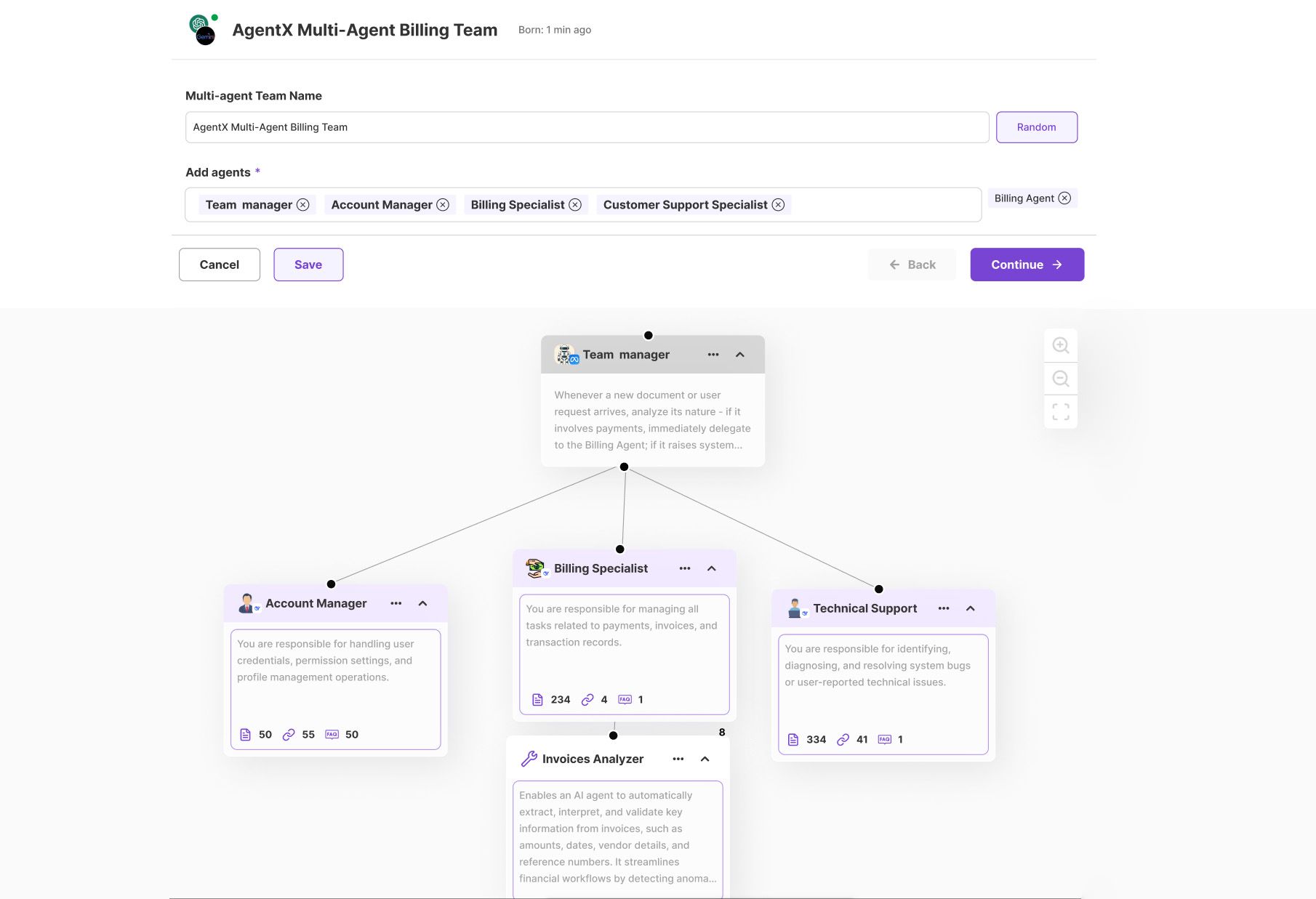
Let’s explore how such a team is composed and how each part contributes to the overall system performance:
1. Manager Agent (Supervisor)
The manager is the user's primary interface. Its job is to:
Understand the user's request.
Break down the request into sub-tasks.
Delegate those sub-tasks to the appropriate specialist agents.
Gather responses and synthesize a cohesive reply.
2. Specialist Agents
These agents each have their own knowledge domain:
Billing Agent: Handles payments, invoices, and transaction history.
Technical Support Agent: Diagnoses and resolves bugs or system errors.
Knowledge Agent: Searches documentation and FAQs.
Account Agent: Manages user credentials, permissions, and profiles.
3. Worker Agents (Optional, deeper layer)
Some complex systems include micro-agents under each specialist. These agents might:
Run backend scripts.
Pull and format data.
Interact with third-party APIs.
All communication flows upward. Specialists return their findings to the Manager Agent, which then communicates directly with the user.
Real-Life Examples
To truly grasp the impact of multi-agent hierarchy systems, it's useful to see how they function in real-world applications. These examples showcase how structured agent teams outperform single-agent models in everyday use cases - whether by increasing speed, improving accuracy, or reducing operational complexity.
Customer Support Automation
Single Agent: A chatbot handles every inquiry, leading to generic responses and frustration.
Hierarchical MAS: The Manager routes to Billing, Tech Support, or FAQs depending on the query.
Result: Faster, more accurate, and more satisfying resolutions.
Autonomous Vehicles
Single Agent: One model makes all driving decisions.
Hierarchical MAS: Navigation, perception, and control agents each handle distinct responsibilities.
Result: Safer and more context-aware driving.
Healthcare Diagnostics
Single Agent: A generalist tries to process complex health data.
Hierarchical MAS: Intake agent collects history, diagnostics agent interprets labs, and recommendation agent suggests treatment.
Result: More precise diagnoses and reduced doctor burden.
The Future of Multi-Agent Hierarchies
Multi-agent hierarchies are laying the groundwork for the future of artificial intelligence - especially in environments where tasks are numerous, evolving, and interdependent. With frameworks like LangGraph and tools allowing for building Agent Workforces such as AgentX, building these systems has never been more accessible.
In the near future, these systems could power everything from enterprise software and digital assistants to smart homes and intelligent cities. Their modularity, resilience, and transparency make them ideal for real-world deployment.
Final Thoughts
The Multi-Agent Hierarchy System offers a blueprint for building AI that is more like us: collaborative, organized, and purpose-driven. As we push toward more general and interactive forms of AI, the principles of hierarchy, delegation, and specialization will be crucial. If you're looking to build AI that can scale with complexity - don’t go it alone. Let your agents work as a team.
Share Blog
Related blogs