

TOPICS
Multi-agent systems

An agent operates as an LLM-driven decision engine that directs application workflows. As these systems evolve into intricate architectures, maintenance and scalability challenges often emerge. Common pain points include -- struggling to choose between too many tools, losing track of too much information, needing specialized agents for different tasks, and hard to collaborate with different teams .
Why do you need Multi-agent systems?
Multi-agent systems (MAS) are becoming a cornerstone in developing intelligent, scalable, and resilient solutions. These systems consist of multiple autonomous agents interacting within an environment to achieve individual or collective goals. Below are the key reasons why MAS are so critical - and how they're reshaping industries from robotics to logistics and smart infrastructure.
1. Solving Complex, Distributed Problems
Modern software problems - like managing distributed services, real-time data processing, or coordinating microservices - are often too intricate for a monolithic or single-agent solution. MAS allow these challenges to be decomposed and handled by specialized agents, each focusing on a slice of the problem.
Example: In a financial fraud detection platform, different agents might monitor transaction anomalies, behavioral patterns, and network threats independently, then collaborate to reach a holistic risk assessment.
2. Parallelism as a First-Class Architectural Feature
One of MAS's inherent strengths is parallel execution. Multiple agents can operate on different tasks or datasets at the same time, without waiting on a central control mechanism. This aligns perfectly with the demands of real-time systems, cloud-native applications, and data pipelines.
Example: In a recommendation engine, user modeling, content scoring, and contextual filtering can be handled by different agents concurrently - dramatically reducing latency.
3. Autonomous Agents Enable Localized Decision-Making
Each agent in a MAS is designed to operate autonomously, reacting to its local context, historical data, or learned policies. This architectural trait is essential in decentralized systems where responsiveness and local intelligence matter more than centralized orchestration.
Example: In a distributed customer support system, one agent may monitor user sentiment, another may select knowledge base responses, while a third handles escalation - all without needing a centralized rule engine.
4. Scalable by Design
Multi-agent systems are intrinsically modular, making it easy to scale horizontally. As the demand grows, new agents can be deployed to take on specific roles or share workloads - with minimal impact on the rest of the system.
Example: In an event-driven architecture, if message volume spikes, new processing agents can be spun up to handle the load without affecting the upstream data ingestion or downstream analytics layers.
5. Collaboration Fosters Emergent Intelligence
MAS architectures allow agents to share knowledge, coordinate actions, and negotiate decisions. This can produce emergent behavior and collective intelligence - particularly valuable in applications like dynamic pricing, adaptive user interfaces, or workflow optimization.
Example: In a SaaS workflow automation tool, agents responsible for email parsing, data extraction, and user alerts can negotiate task priority and streamline user interactions based on shared context.
6. Robustness Through Decentralization
In MAS-based architectures, there’s no single point of failure. If one agent fails, others can continue operating, or even redistribute responsibilities dynamically. This leads to higher availability and fault tolerance.
Example: In a serverless architecture, if one lambda-based agent responsible for metadata processing fails, others can detect the backlog and redistribute the job queue - without affecting the overall system health.
7. Adaptability for Dynamic Environments
Software systems must increasingly adapt to changing inputs, APIs, user behaviors, and external conditions. MAS agents can update their behavior or strategies in response to new data or environment shifts - often without a full redeployment.
Example: In a real-time personalization system, agents can tune recommendations based on seasonal trends or user behavior drift, adapting their logic without hard-coded changes.
Rule-Based Agentic Workflows vs. Multi-Agent Systems: A Modern Software Architecture Perspective
As the concept of agent-based software gains traction, two paradigms often get conflated: rule-based agentic workflow systems and multi-agent systems (MAS). While both involve agents, autonomy, and task orchestration, they differ significantly in flexibility, architecture, scalability, and use cases.
Let’s break down how they compare - and when you might choose one over the other.
Rule-Based Agentic Workflow Software: Deterministic, Directed, and Linear
Rule-based agentic workflows typically follow predefined logic trees or if-this-then-that rules. They’re often designed for clarity, auditability, and predictability.
These systems usually involve:
A centralized controller or orchestrator defining workflows.
Stateless agents or modules that perform specific tasks on demand.
Explicit rules that determine how tasks are triggered or delegated.
Strengths:
✅ Control: Deterministic flows ensure consistent behavior.
✅ Simplicity: Suitable for straightforward simple automation scenarios.
Limitations:
❌ Rigidity: Doesn’t adapt well to changing data or environments.
❌ Scalability: Scaling workflows often involves copying rules or duplicating logic.
❌ Low autonomy: Agents depend on external instructions rather than reasoning locally.
❌ Complexity: The whole system gets too complicated when the application gets bigger.
Example: A CRM automation system where an "Email Follow-Up Agent" is triggered only when a user clicks a link, based on an explicit rule written in a drag-and-drop workflow builder.
Multi-Agent Systems (MAS): Decentralized, Autonomous, and Adaptive
MAS are more decentralized and intelligence-driven. Each agent has its own goals, reasoning capabilities, and decision-making logic. Instead of a central conductor dictating every step, agents negotiate, collaborate, and self-organize.
These systems involve:
Autonomous agents that make decisions based on local knowledge.
Emergent workflows, where task flow arises dynamically.
Communication protocols for agents to share knowledge or coordinate.
Strengths:
✅ Adaptability: Agents can adjust behavior based on environmental changes or learned experience.
✅ Scalability: New agents can join or leave without redesigning the entire system.
✅ Resilience: Decentralized design makes the system robust to partial failures.
Limitations:
❌ Overkill: Not suitable for simple straightforward tasks.
❌ Emergent behavior: Outcomes are not always predictable.
Example: In a cloud cost optimization platform, one agent might monitor usage trends, another might predict future workloads, while a third negotiates reserved instance purchases - all interacting asynchronously without central coordination.
Multi-agent architectures
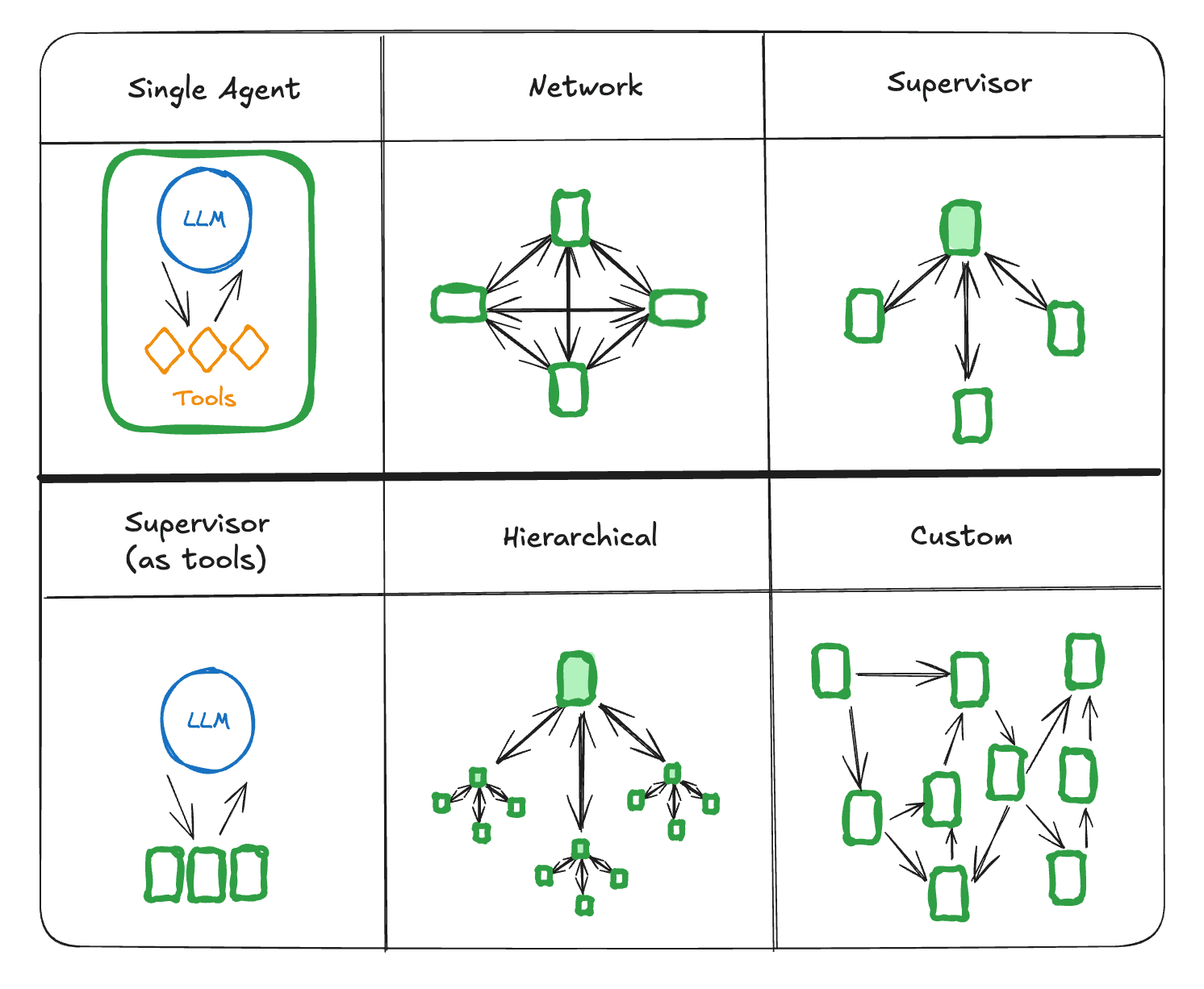
Multi-agent systems can be organized in several ways:
Network Architecture: All agents communicate directly with each other, with each agent independently deciding which agent to invoke next.
Supervisor Architecture: A central supervisor agent manages communication, deciding which agent to activate next.
Tool-Calling Supervisor: A specialized supervisor treats agents as tools, using an LLM to dynamically select agents (tools) and their arguments.
Hierarchical Architecture: A layered approach with supervisors managing other supervisors, enabling more complex control flows.
Custom Workflow: Agents communicate selectively, with some connections fixed determined by the setups. (More like rule-based workflow)
The Central Role of Planning in Multi-Agent Systems
Many MAS architectures still depend on a central or “main” agent - often referred to as a coordinator, orchestrator, or planner - that interprets the goal, analyzes inputs, and allocates responsibilities to sub-agents. The success of the entire system hinges on how well this main agent understands the task, the environment, and the capabilities of each sub-agent.
In practical terms, this agent often answers key architectural questions like:
What is the overall objective, and how can it be decomposed?
Which agents are best suited for each subtask?
How should the agents coordinate or communicate?
What contingencies should be in place for failure recovery?
If this planning step is weak - say, misinterpreting ambiguous instructions or failing to align subtasks correctly - the rest of the agent network can quickly devolve into inefficiency or conflict, even if the sub-agents themselves are well-designed.
The Rise of "Deep Thinking" in LLMs: Planning Gets an Upgrade
One of the key bottlenecks in building intelligent MAS has been the limited reasoning ability of planning agents. Early agent frameworks often relied on rule-based planning, heuristic trees, or shallow prompt chaining. These methods work well in narrow domains but struggle with open-ended, ambiguous, or dynamically evolving tasks.
Now, with the rise of Large Language Models (LLMs) optimized for reasoning and planning, this is changing dramatically.
What's New in LLM-Enhanced Planning?
Step-by-step decomposition: Newer LLMs (like GPT-4 Turbo, Claude 3, Gemini 1.5, etc.) are capable of breaking down high-level goals into well-scoped subgoals, with awareness of logical dependencies and sequencing.
Contextual task routing: The planner can choose the right agent (or tool) based on the type of task, using embeddings, metadata, or past performance.
Reflective reasoning: Models can assess their own outputs, correct themselves, and refine plans before execution.
Memory and long-context understanding: With longer context windows (100K+ tokens), LLMs can now analyze richer datasets or chains of prior events to inform more holistic plans.
These features allow the main agent in a MAS to evolve from a brittle rule engine into a robust, adaptive strategist - capable of deeply understanding not just "what needs to be done," but why, when, and how to do it across a team of agents.
From Execution Chains to Cognitive Ecosystems
We are witnessing a shift: instead of agents merely "calling" each other like function pipelines, we are beginning to see cognitive ecosystems - environments where agents negotiate, reflect, retry, and even teach one another, all guided by a deeply capable planning core.
This shift brings benefits like:
Improved task completion rates, especially on open-ended or long-horizon tasks.
More graceful failure recovery, since plans include fallback strategies and check-ins.
Higher autonomy, with agents making nuanced decisions without constant human prompts.
Increased transferability, as planners can apply abstract strategies across domains.
The Future: Hierarchical and Reflective MAS
As deep planning LLMs continue to improve, the next step is likely hierarchical multi-agent systems:
A meta-agent oversees planning and evaluation.
Mid-level agents manage subdomains or workflows.
Lower-level agents handle atomic actions or specialized tasks.
Combined with memory, feedback loops, and long-context reasoning, this structure allows MAS to scale in complexity without losing coherence.
That’s where AgentX comes in.
AgentX is a next-generation multi-agent orchestration platform built to help businesses achieve complex goals with intelligent software agents. Designed from the ground up with deep LLM integration, robust task delegation, and business-aligned reasoning capabilities, AgentX acts as both the brains and backbone of your enterprise automation.
Whether you’re optimizing operations, scaling knowledge work, or building adaptive customer experiences, AgentX empowers your teams with:
🧠 LLM-enhanced planning agents that understand your objectives and translate them into executable strategies.
🤖 Specialized sub-agents that handle tasks like data processing, content generation, market analysis, and more - each working autonomously but collaboratively.
🔄 Continuous feedback loops for reflection, correction, and improvement - no more brittle automation chains.
📊 Enterprise-grade visibility and control, so you can trust the system while staying in the loop.
AgentX doesn’t just automate tasks - it aligns intelligent agents with your business outcomes, enabling software that plans, adapts, and collaborates like a real team.
Share Blog
Related blogs