

AI AGENT TRENDS
Boost Productivity: Understanding Knowledge Base and RAG Technology with AgentX

A knowledge base is more than just a collection of documents; it’s a centralized repository that helps organizations store, organize, and retrieve vital information.
What is a Knowledge Base?
Picture this: you’re at work, and you need to find the latest policy on remote work. Instead of sifting through endless emails or asking colleagues, won't it be nice to have a system where you simply ask and it will find the answer in seconds with the source references. That’s the power of an effective knowledge base management.
Why Do Organizations Need a Knowledge Base?
Have you ever struggled to locate important information at work? Many employees face this challenge daily. A well-structured knowledge base can significantly enhance productivity by reducing search time. For example, companies like HubSpot have successfully implemented knowledge bases that empower their teams to resolve customer inquiries quickly and efficiently. With features like robust search functionality and user-friendly design, these platforms make finding information effortless.
Moreover, knowledge bases support continuous learning within an organization. They allow teams to document lessons learned from past projects and adapt based on feedback. As businesses grow and evolve, keeping this information current ensures everyone stays informed about best practices.
Benefits of a Knowledge Base:
Improved Efficiency: Quick access means less downtime.
Enhanced Collaboration: Teams can share insights easily.
Customer Empowerment: Public-facing knowledge bases enable customers to find solutions independently.
Imagine having all your organization’s critical data at your fingertips—no more digging through files! This not only saves time but also fosters a culture of collaboration where everyone feels empowered to contribute.
The Mechanics of Knowledge Bases
Have you ever wondered how companies manage to provide instant answers to your questions? Knowledge bases (KBs) are the unsung heroes behind this seamless experience. These structured repositories are designed to store, manage, and retrieve information efficiently, making them essential in today’s data-driven world.
Structure of Knowledge Bases
Knowledge bases are interconnected networks of information. They consist of entities—think products or concepts—along with attributes that describe these entities. For example, consider a customer support knowledge base for a tech company. It might include product specifications, troubleshooting steps, and user reviews all linked together. This structure allows users to navigate complex relationships between different pieces of information easily.
Types of Data Stored
Knowledge bases can house various types of data:
Structured Data: Numerical values or categorical data stored in a predefined format (like databases), allowing for easy sorting and analysis.
Unstructured Data: Textual content such as manuals that don’t follow a specific format but still hold valuable info. Usually in document format (PDF, word, etc.)
Semi-structured Data: A mix where data doesn’t reside in a rigid structure but retains some organizational properties (e.g., JSON files, excel, csv).
FAQs: Frequently Asked Questions provide quick answers to common inquiries, crucial for enhancing customer support efficiency.
Website Content: Information available on company websites, including product descriptions and service details that help users make informed decisions.
Chat Logs: Transcripts from customer interactions that can reveal common issues and improve future responses.
Emails: Correspondence containing insights or answers relevant to user queries, often overlooked yet valuable.
By integrating these diverse data types, knowledge bases can deliver comprehensive answers tailored to user needs.
Retrieval Processes
Retrieval is where the magic happens—how users access the wealth of information stored in a knowledge base. Imagine you’re troubleshooting an issue with your smartphone; you type your question into the support site’s search bar. Here’s how retrieval methods come into play:
Keyword Search: You input specific terms; the system retrieves documents containing those terms. This method is straightforward but may not always yield the best results if your phrasing differs from what’s stored.
Semantic Search: This goes beyond keywords by understanding context and meaning. For instance, if you search “battery life issues,” it might pull up articles about battery optimization even if those exact words aren’t used.
Recommendation Systems: These suggest related articles based on previous interactions or common queries. If you just read about battery care tips, it might recommend articles on general phone maintenance next.
These retrieval methods significantly impact user experience by ensuring that relevant information is easily accessible when needed most.
Role of Vector Databases in Retrieval-Augmented Generation (RAG)
A vector database stores high-dimensional data as numerical embeddings, allowing for efficient similarity searches. These embeddings represent the semantic meaning of various types of information, such as text or images.
Role of Vector Databases in Retrieval-Augmented Generation (RAG)
Efficient Data Retrieval: Vector databases enable quick retrieval of relevant documents by converting queries into vectors, speeding up the search process.
Improved Contextual Relevance: RAG systems pull contextual information from vector databases, ensuring generated content is accurate and aligned with user intent.
Scalability: They manage large datasets effectively, allowing RAG systems to maintain long-term memory by storing diverse information.
RAG and vectorDB has been adopted by many big player such as AWS.
Components of RAG
At its core, RAG combines two main components: a retrieval system and a generation model. The retrieval system searches for relevant information from a curated database or knowledge base in real-time. Once this information is retrieved, it feeds into the generation model, which crafts responses that are not only contextually relevant but also enriched with up-to-date facts.
Retrieval System: This component identifies and pulls pertinent data from external sources, ensuring that the information used in responses is accurate and timely.
Generation Model: Leveraging the retrieved data, this model generates coherent and context-aware text, improving user interactions significantly.
Hybrid Search: Hybrid search methodology combines the precision of keyword-based searches with the contextual understanding of semantic searches. This dual approach ensures that users can find relevant documents whether they match exact keywords or are semantically related to their queries.
Enhancements Over Traditional Models
Traditional AI models often struggle with providing accurate answers due to their static nature; they can only generate responses based on their training data without access to new information. In contrast, RAG systems dynamically pull in current data, allowing them to deliver more precise and informative outputs.
For instance, chatbots powered by RAG can offer detailed answers about recent events or specific queries that require specialized knowledge—something standard models might falter at. By grounding their responses in real-time data, these systems improve user experience through enhanced relevance and accuracy.
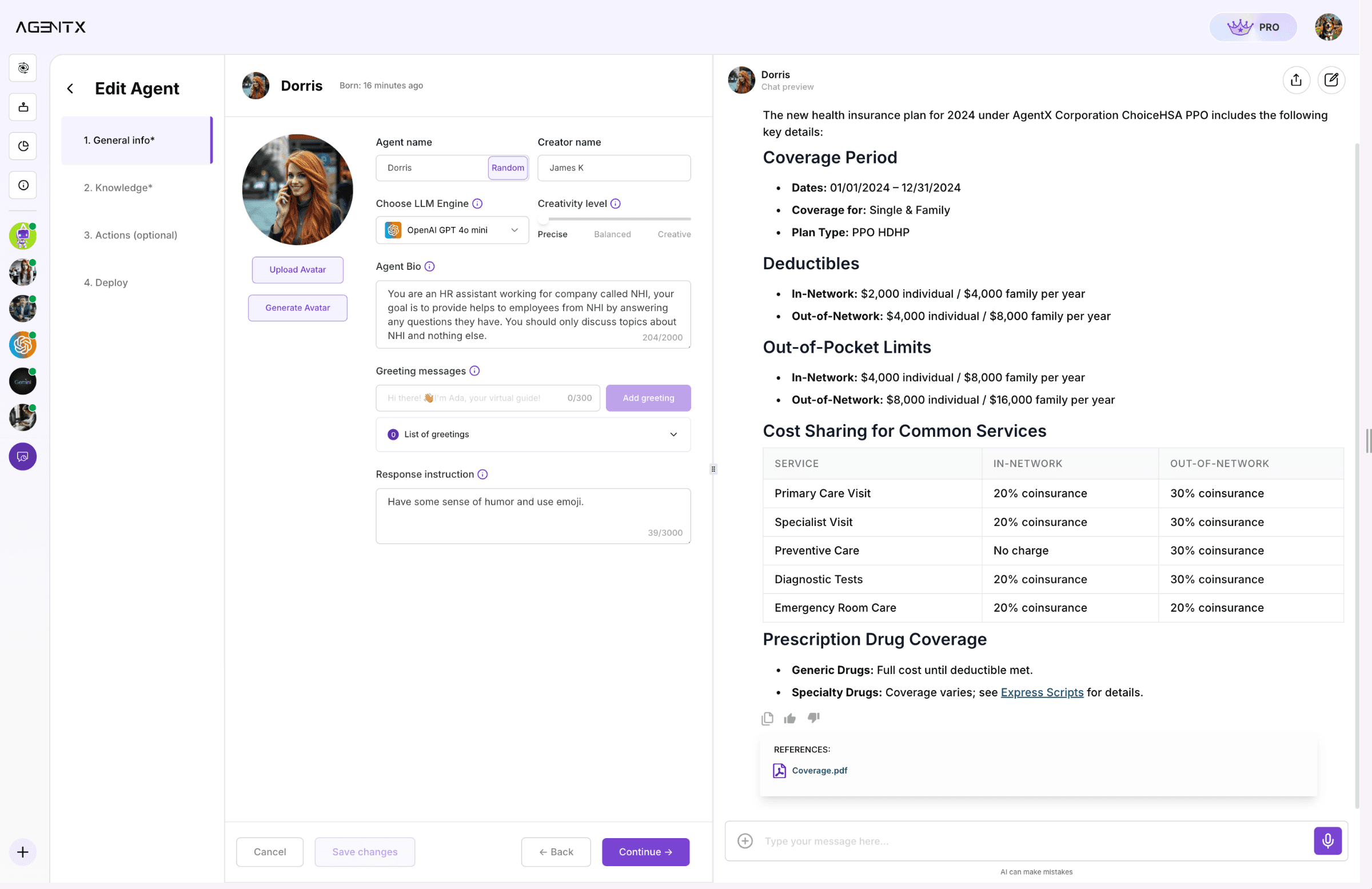
AgentX - AI Agent with RAG Technology
AgentX is at the forefront of integrating Retrieval-Augmented Generation (RAG) technology into business operations, transforming how organizations harness AI to enhance efficiency and productivity. This innovative approach combines the strengths of retrieval systems with generative capabilities, allowing businesses to access vast amounts of information quickly while generating insightful responses tailored to specific needs.
Enhancing Efficiency Through RAG
At its core, RAG technology empowers AI agents to retrieve relevant data from extensive databases or knowledge bases before generating responses. This dual capability ensures that the information provided is not only accurate but also contextually relevant. For instance, when an employee queries an AI agent about a complex project, the agent can pull in real-time data and insights from previous projects or industry benchmarks, leading to more informed decision-making.
By automating these processes, AgentX reduces the time employees spend searching for information and increases their focus on strategic tasks. According to a recent article on Aisera, this shift allows teams to dedicate more time to creative problem-solving rather than mundane administrative duties.

Driving Productivity with Intelligent Agents
The implementation of RAG technology by AgentX not only streamlines workflows but also enhances overall productivity. With AI agents capable of learning from interactions and continuously improving their responses through memory features, businesses can expect a significant boost in operational efficiency. As highlighted in a LinkedIn post, organizations leveraging these intelligent agents are experiencing faster turnaround times and improved service delivery.
Moreover, RAG-equipped agents facilitate better knowledge management by ensuring that critical information is always accessible. This capability transforms how teams collaborate and share insights across departments, breaking down silos that often hinder progress.
Real-World Applications
Businesses across various sectors are already witnessing the benefits of adopting AgentX's RAG technology. For example, companies involved in customer service can deploy AI agents that not only answer inquiries based on historical data but also adapt their responses based on evolving customer needs. This adaptability leads to enhanced customer satisfaction and loyalty.
Some case studies:
AgentX provides enterprise RAG for Human Resources knowledge management.
AgentX empowers the company's employee training with enterprise RAG.
Step-by-step tutorial to create an AI agent for company's HR virtual assistant.
Conclusion
RAG technology plays a crucial role in this transformation. By combining retrieval capabilities with generative models, it empowers AI agents to fetch pertinent information and synthesize it into coherent responses. For instance, as highlighted in an article from Cisco, RAG allows businesses to leverage vast datasets effectively, making knowledge management more agile and responsive.
Moreover, RAG supports continuous learning within organizations. As these systems interact with users and gather feedback, they evolve over time, improving their ability to serve diverse needs across departments.
Businesses that embrace knowledge bases and RAG technology are well-positioned to achieve better outcomes. By investing in these innovative solutions, organizations can unlock their full potential and thrive in an increasingly competitive landscape.
Now is the time to take action. AgentX offers out-of-box RAG technology combined with vector database and AI agents services - schedule a demo with AgentX to get an exclusive peek on how enterprises are leveraging AI agents and RAG technology to boost their productivity.
Share Blog
Related blogs