

AI AGENT TRENDS
What is AI Agent 🤖?

In an age where technology seamlessly integrates into daily life, understanding the underpinnings of artificial intelligence (AI) is more relevant than ever. Central to this technological renaissance are AI agents, a cornerstone of how machines interact with, learn from, and adapt to the human world. This guide will shed light on what AI agents are and their transformative role in diverse industries.
I. Demystifying AI Agents
What is an AI Agent?
An AI agent refers to a system that is capable of autonomous actions in an environment to achieve designated goals. These entities or programs can make decisions, perform tasks, and even learn based on their programming and interactions. AI Agents work hand-in-hand with and complement large language models (LLMs).
Typically, AI agents possess the following characteristics [1]:
Planning: ability to break up a goal into manageable sub-goals and self-improve from past actions
Memory: short-term memory for in-text learning and long-term memory for knowledge base learning
Tool use: ability to call external APIs
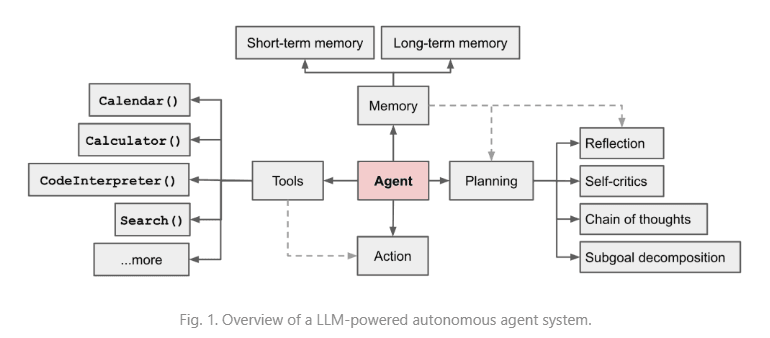
With these capabilities, AI Agents should be able to understand instructions from humans in their natural language and execute actions ordered by humans. Just like in the past a manager of a company may ask a team member to place an order or write a summary, the team member can now be replaced by an AI Agent trained with knowledge required for placing the order or writing the summary.
AgentX is a platform that allows users to build such AI Agents. Users may build AI Agents like chatbots by uploading pdf knowledge or website knowledge, and deploy them on their own websites. Essentially, you can configure the memory and tool use of the AI Agent to fit your needs.
The Evolution of AI Agents 🌐
From rudimentary chatbots in customer service platforms to sophisticated decision-making systems, AI agents have evolved significantly. Early iterations functioned purely on rule-based logic—very much 'if x condition happens, do y action'. As technology advanced, machine learning allowed these agents not just to follow instructions but also adapt based on data—a quality synonymous with intelligent behavior.
How Do AI Agents Work? 💼
At their core, AI agents work by constant input-processing-output cycles involving data from their surrounding environment. This involves sensor readings which could be anything from direct user input via typing or clicking to passive data collection like browsing cookies or device usage metrics.
Sophisticated models apply algorithms that allow these agents to understand context (Natural Language Understanding), decipher meaning (Natural Language Processing), predict outcomes, and learn from these encounters for future improvement—a process known as machine learning.
II. Types of AI Agents 💬
An understanding of the different types of AI agents illuminates the breadth of their capabilities and applications.
Simple Reflex Agents
These are the most basic type of agents which operate on condition-action rules. They work by directly mapping a perceivable condition to an action, making them suitable for processes that require immediate and specific responses.
Model-Based Reflex Agents
Such agents take it a step further by maintaining an internal model or state that reflects the agent's understanding of the world. Model-based reflex agents can handle a partially observable environment by using this internal state to derive their actions.
Goal-Based Agents
These agents are more sophisticated as they take action to achieve certain goals. They evaluate various possibilities, consequences, and paths before deciding on a course of action that leads them closer to their defined objective.
Utility-Based Agents
Utility-based agents go beyond goal completion; they evaluate success based on a performance measure provided by a utility function. These are often employed in situations where accomplishing the goal with optimal performance is required.
Learning Agents
Perhaps the most advanced type, learning agents have the capacity to learn from their environment and improve over time. They analyze past actions and results to adjust future behaviors for better outcomes.
The varied types confirm AI agents' flexibility and potential for almost limitless applications in today's digitized landscape.
III. Applications of AI Agents in Various Sectors 📋
AI agents have made significant inroads across various sectors owing to their ability to simulate human interaction and automate tasks.
Customer Service
In customer service, chatbots alleviate workload by handling commonly asked questions, freeing human representatives for intricate issues.
Healthcare
In healthcare, diagnostic tools powered by AI swiftly interpret patient data offering insights into potential health risks or tailored treatment plans—a feat impossible without such advanced analysis capabilities.
Finance
In finance, AI agents detect suspicious activities indicating frauds thanks to pattern recognition abilities far beyond what human auditors could perceive given large datasets they handle.
IV. Building an AI Agent 🛠️
The process of building an AI agent is multi-faceted, involving a combination of robust technologies and logical structuring.
Requirements Gathering for an AI Agent
Defining clear requirements forms the bedrock here ensuring subsequent development aligns with desired objectives set out early stage project inception phase itself—understanding what tasks agent must perform helps dictate technical necessities involved build process later stages.
Tools and Technologies Used in Constructing AI Agents
AgentX offers AI Agent building platform to users with no coding experience. Configuration can be done in minutes using simple data entry and copy & paste. Building AI Agents has never become so easy, and deploying them takes just one minute. Explore AgentX’s AI Chatbot at the bottom right corner here.
V. The Future Potential of AI Agents 🚀
As technology advances, so does the potential of AI agents.
Advancements on the Horizon
The horizon promises further advancements in personalized and predictive analytics, deeper machine learning integrations, and multi-faceted autonomous operations that could redefine industries.
Challenges Ahead for Further Development
Despite tremendous potential, challenges persist, such as ensuring fair algorithms free from bias, safeguarding privacy while handling vast amounts of data, overcoming technical limitations to improve language understanding further, and enhancing user trust in these automated systems.
VI. Ethical Considerations for Using AI Agents 👍🏼
Utilizing AI agents comes with ethical responsibilities.
Privacy Concerns With Data Handling by Automated Systems
Handling personal information responsibly is crucial for developers creating agents that learn from a wide range of data sources. Maintaining encryption standards and adhering to privacy laws are just some ways the industry faces these challenges. AgentX is committed to protect your privacy. You are invited to visit the privacy policy.
VII Case Studies: Successful Implementations 🎉
Successful implementations of AI agents are numerous, ranging from Siri's assistance on millions of devices to smart home systems learning residents’ habits to conserve energy effectively while providing comfort.
Conclusion
Artificial intelligence agents are innovative tools capable of transforming daily tasks into streamlined interactions. As we've explored their intricacies—types of agents, their applications across sectors, how they're built using various tools—all while considering future potentials and ethical considerations—the insight obtained underscores their influential presence in our connected world.
AI agents bridge gaps between complex technological processes and user-friendly experiences. Whether you're a developer curious about crafting these intelligent entities or simply fascinated by their capabilities—today's potential is only scratching the surface. As ecosystems evolve around machine learning advancements, we stand at the threshold where imagination meets tangible reality through artificial intelligence agents.
From all that we have discussed here today about "what is an AI Agent," it is clear that there's a thrilling journey ahead for those who dare!
Reference:
Share Blog
Related blogs